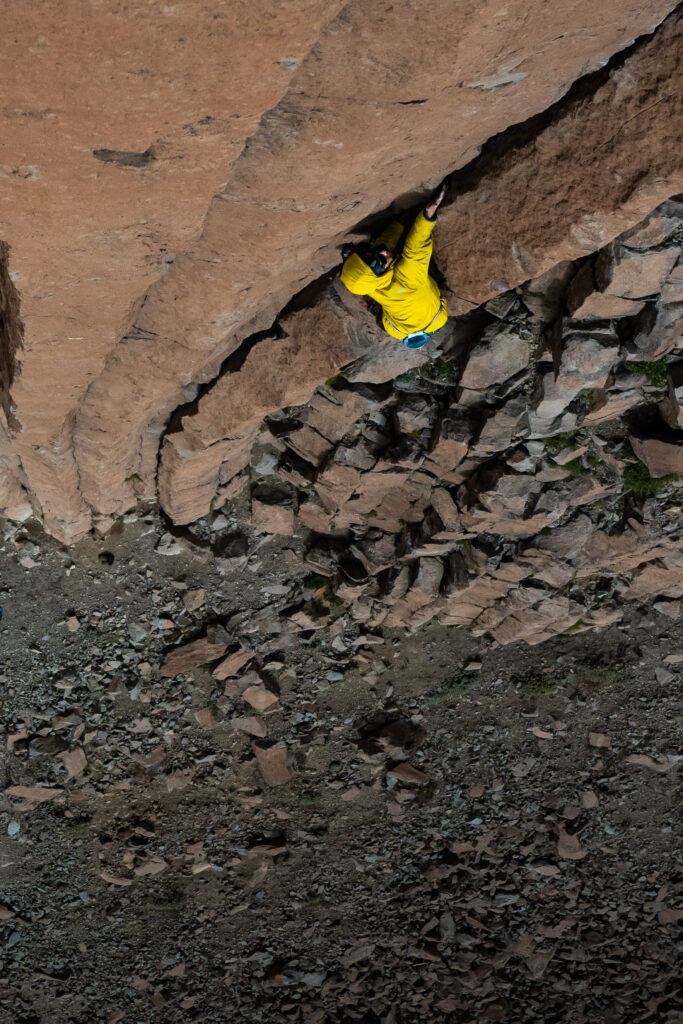
‘Slowly I began to win my fight against panic, but as I calmed, a flood of unwanted thoughts stormed my brain. Surprisingly, shame was perhaps the strongest. I felt like the world’s biggest shit-show. My deep and hidden psychological reasons for soloing were suddenly laid bare; soloing isn’t bad-ass, rather it’s a child’s delayed response to some early ass-beating or humiliation, a feeble attempt to fix a long suppressed trauma by facing down a lesser fear. You can tell yourself it’s about freedom, and that’s true to some degree, but it’s only a tiny part of the story. A successful soloist learns to tune out the fear, but you won’t really know what it’s all about until that fear hits you, or until you fall.’
(Jim Thornburg)
‘As for the dangers, since having health problems a few years back, I have a different perception of longevity and its usefulness. I am very aware that there are no certainties, and that it is worth trying to rip as much juice as possible from every opportunity that arises’
(Rolando Garibotti)
‘I would say that the need to climb comes from that tough, lonely place of searching for your dignity. You know, that place – where we actually choose to confront our own weaknesses and fears, where we rebel against the terror of death – is really about dignity. That’s why alpinism is not just the act of ascending a mountain, but also inwardly of ascending above yourself’
(Voytek Kurtyka)
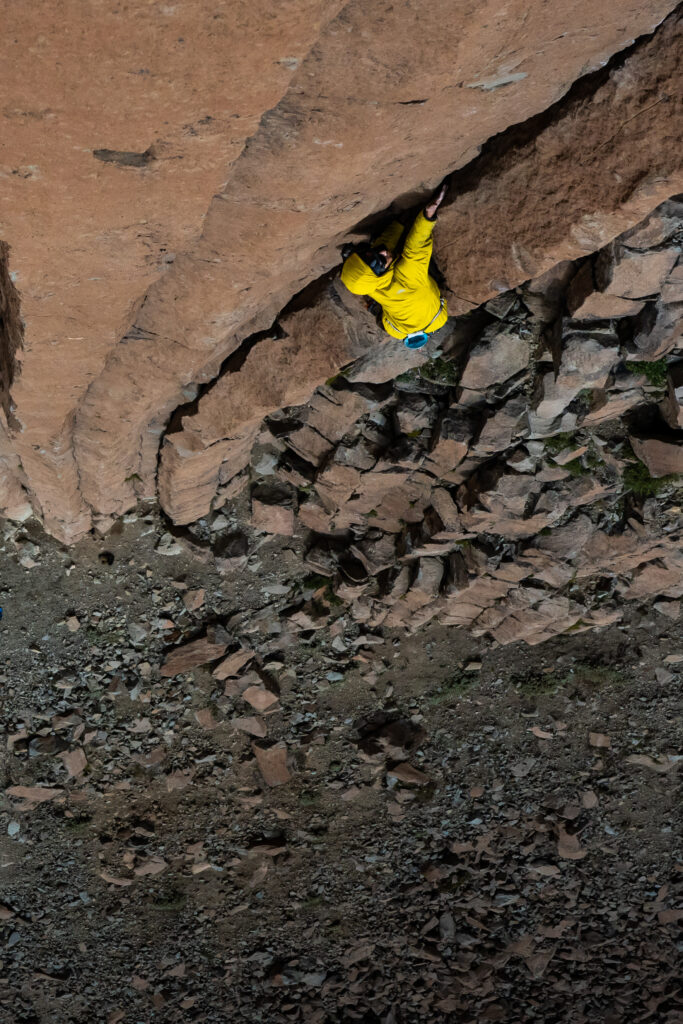
Last month I ‘on-sight’ free-soloed the classic Colombianos (450m 10-) in San Gabriel. On-sight is in quotes here because technically it was not an on-sight as I had climbed the first easy pitch with Joaco when we tried to do El Jote and Colombianos in a day. We bailed, which was my fault as even though I carried the team in the first half leading and freeing all of El Jote, I wanted to see the summit as it was only my second time in San Gabriel (I’d previously only been here 3 years ago when I was still learning to trad climb). By the time we got to the anchors of the first pitch of Colombianos we decided to bail because of the hour. I wasn’t really bummed though as these days I try not to cling onto any specific outcome or objective but rather try to live the present regardless of the situation (climbing and life is a lot more enjoyable this way ;)). Hiking down the trail in the golden afternoon light it occurred to me that having not gotten onto the meat of the climb, I could try to ‘on-sight’ free-solo the 450m granite crack climb.
I’ve an uncomfortable relation with the idea of free-soloing. Watching and hearing of other people free-soloing makes me question ‘why?’ Why climb without a rope where one mistake, one slip of the foot, can end up taking everything away? When my friend Chomingo casually free-soloed the Piedra Parada in Argentina with an injured finger, we were all psyched for him. Privately though, I had a word with him on being careful. Another friend would go on to post frequent free-solos on his Instagram. Out of concern, I questioned his motives. In a world and age where self-values often depend on impressing and wowing others, free-soloing mixes uncomfortably with all the other ‘look at me’ posts. Would you do it if nobody knew? Why?
In Climbing Magazine’s selection of best articles, there is a short but significant section on free-soloing and depression. Three unique stories in which each protagonist loses the battle with the ‘black dog’ and choose to climb sans cord with the expectation to fall along the way. Only they don’t fall. Having dealt with the heavy weight of depression myself, I admit to having fantasized, in those darker moments, about free-soloing as a majestic way to end this potentially unbearable life. However, today I am completely free of the roots of depression. I am in love with life. This is an attitude which I carefully cultivate through mindfulness. Happiness lies not through material achievements but from the freeing of the mind. The realization of the impermanence of everything and the trappings of the mind allow me to be fully present to the beauty of life. Past and future are of no consequence. Only the present exists. So why do I need to climb without a rope?
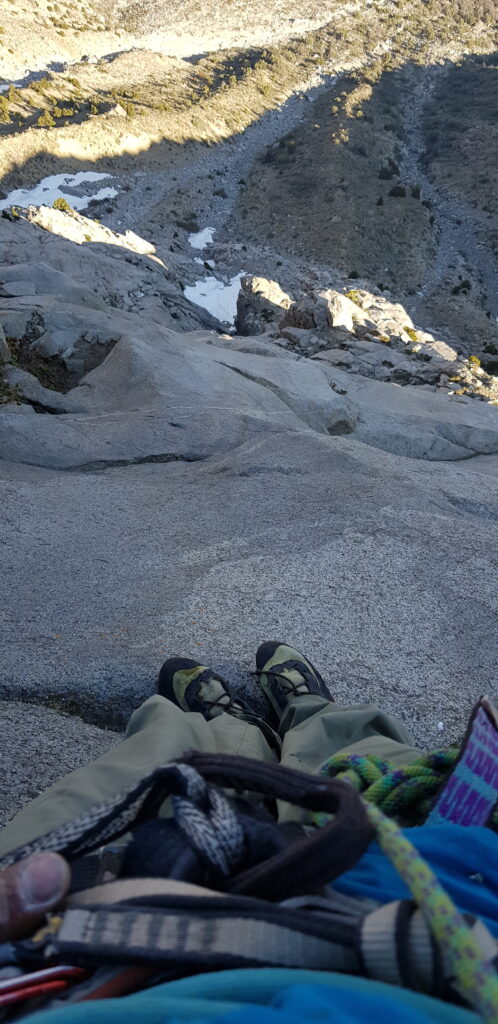
Freedom is the most important element of life for me. Freedom to express myself, freedom from social constraints, freedom from emotional restraints, freedom from concepts and systems, freedom from the ego, and what the Buddhists express as freedom from freedom itself. This does not mean that I believe it my given right to be an immoral being with no restraints as enshrined in our capitalist system. In fact, quite the opposite. To be an animal in the wild places; to be alone, yet at the same time intimately connected to the network of life and energy one only truly experiences in solitude, is true freedom. Climbing is a vehicle through which I can explore this freedom. When I am in a pristine alpine environment, my soul and imagination flies. In a world without rules, concepts and falsely perceived values, one simply explores…
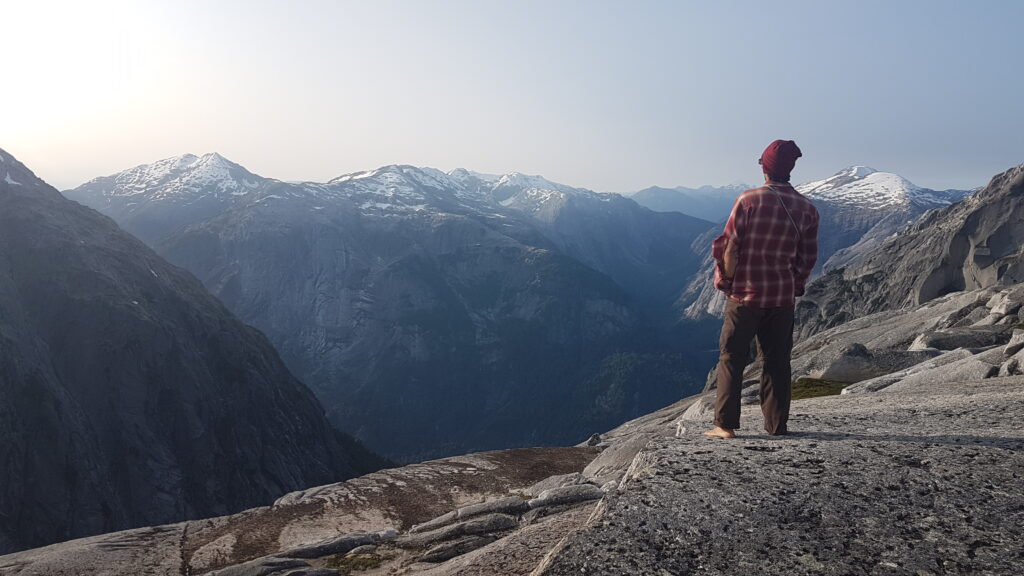
In the established norms and concepts of mainstream climbing there are many styles and standards one chooses (or refuses) to follow based on tradition and personal ethics. Unlike organized sports, it is a very personal choice on how one chooses to practice climbing. There is no referee, no disapproving teacher or corporate soul-less authority. How one chooses to move and interact with the environment is purely down to oneself (and his partners). The most obvious differences in styles are manifest in the gear used and level of safety. The less clutter, the better the style; the more natural, the better. The best style would be to on-sight free-solo naked with no shoes or chalk something aesthetically beautiful that no one has climbed before. Obviously this means the risk factor increases with “better” style; but that is part of the appeal and beauty of climbing for me.
Risk and perceived risk are objectively relative concepts. Someone that has trained and practiced tightrope walking for the entirety of their life, would not consider it a significant enough risk to walk across the same rope for the millionth time. On the other hand someone who has never even heard of the idea of walking across a rope will consider it a highly risky and foolish endeavor. In the event of a fall, the end-result would be the same for both; however, the probability of such an event is vastly reduced for the trained and confident individual. We take risks all the time; some conscious, the majority unconscious. Those who fear the worst outcomes are those that go through life gripped with uncertainty and anxiety.
I cannot remember ever having top-roped due to fear, and when motivation is high I always want to lead and put myself on the sharp end. When I leave the ground, I always give everything. Adrenaline never plays a part, only a calm confidence in my ability to read the rock and trust in my feet. Throughout the years my sensitivity to feel and read different types of rock has developed to the point where I intimately trust both myself and the rock. Climbing is no longer a conscious process but rather an automatic one in which I am an active observer carried by my body. Climbing is not a brute strength activity in this state but one of precision and technique, of contortion within 3-dimentional space, of texture, feel, subtle balance and economy of movement. It is only natural that my evolution as a climber in this context would lead me to carefully pursue certain styles which challenge me both mentally and physically.
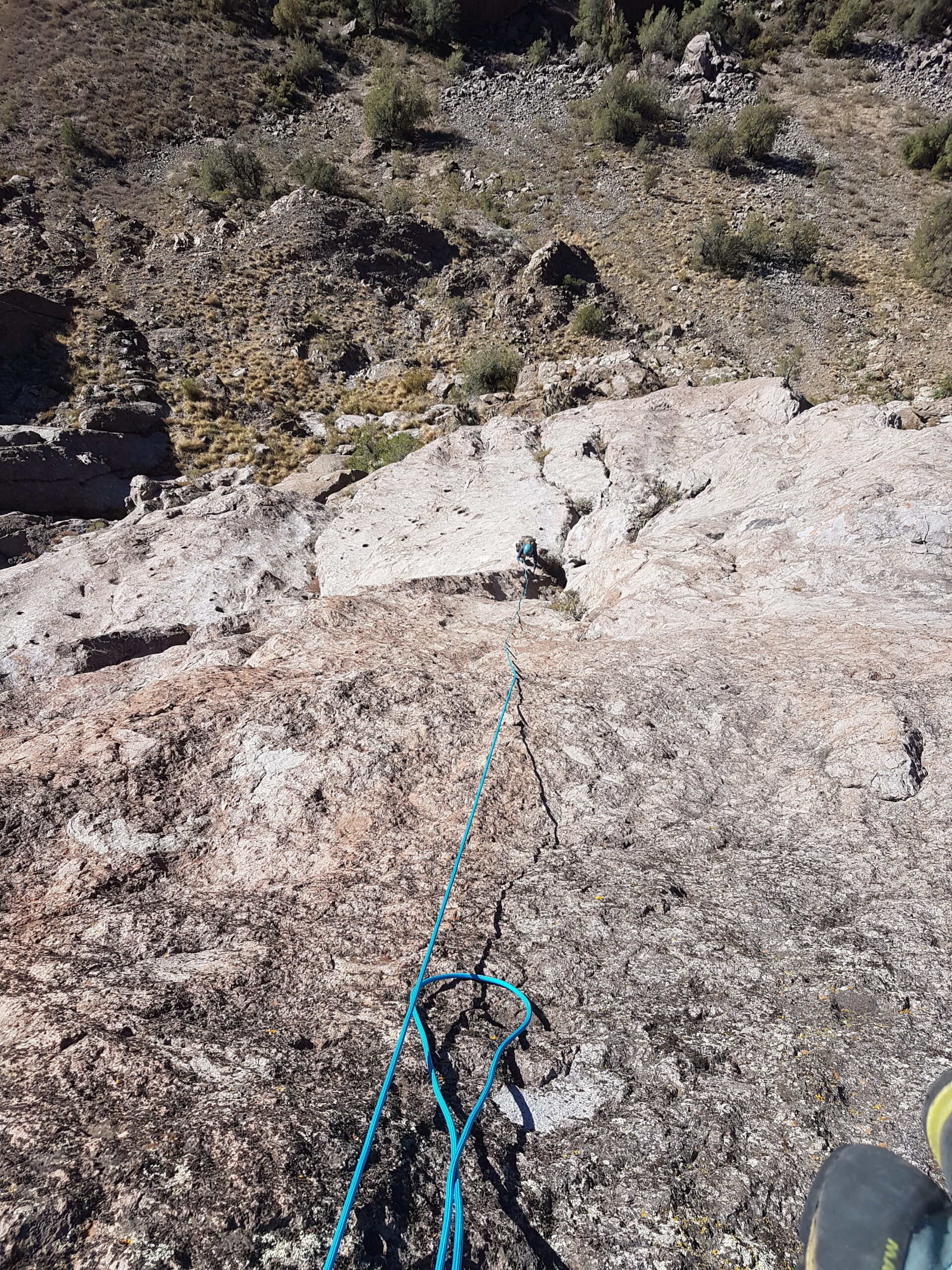
Climbing in high risk situations require a very good understanding of the self and the situation. I do not consider myself a reckless climber, quite the opposite in fact. In everyday life I am known to be what the Chileans call “volado” – often getting sidetracked and forgetting things – however in climbing I compensate for this by being as meticulous as I can be in both my knowledge and awareness of the situation. All other factors aside, I must carefully measure my motivation to make that most crucial of decisions: to go for it, or bail. Overconfidence and uncontrolled motivation are generally positive traits to have in controlled settings; however, I am very well aware that it can be a lethal combination. I follow too many disabled ex-climbers to not be conscious of the high price of a mistake in judgment. This may sound very grim but really I can say the same thing for something like driving which is an even higher risk activity.
In this first world modern lifestyle of comfort and convenience, the main point of life seems to be to live as long as biologically possible and surround ourselves with material objects and achievements in the vain hope of achieving a semblance of meaning and immortality. To me this is not living. It is a slow death of the soul and mind as it becomes trapped in the muck of false illusions. As long or short life may be there is ultimately no point to it at all (except, perhaps, to escape the cycle of Samsara; but that is for another conversation). And this understanding is very liberating. Life is an unplanned adventure with no guarantees; and a very beautiful one at that.
Personally, on-sight free-solo climbing is the purest expression of this; to confront an unknown vertical path with no prior information, relying solely on one’s accumulated experiences, senses, and judgments to navigate oneself to the top and get back down. On-sight climbing (approaching a climb with no prior information) is a very beautiful, intellectual, and creative way to climb as it presents the challenge and excitement of solving a series of natural puzzles for the first time. Free-solo climbing is a test of mental comfort in high risk settings where failure is not an option. To blindly go rope-less up a climb for the first time is obviously highly risky. I keep such excursions to an absolute minimum; and when I do make the judgment to do so, it is with a cold, calculated evaluation of all factors erring on the side of risk reduction. Which brings me back to the decision to ‘on-sight’ free-solo Colombianos.
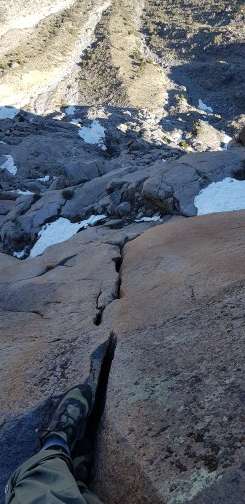
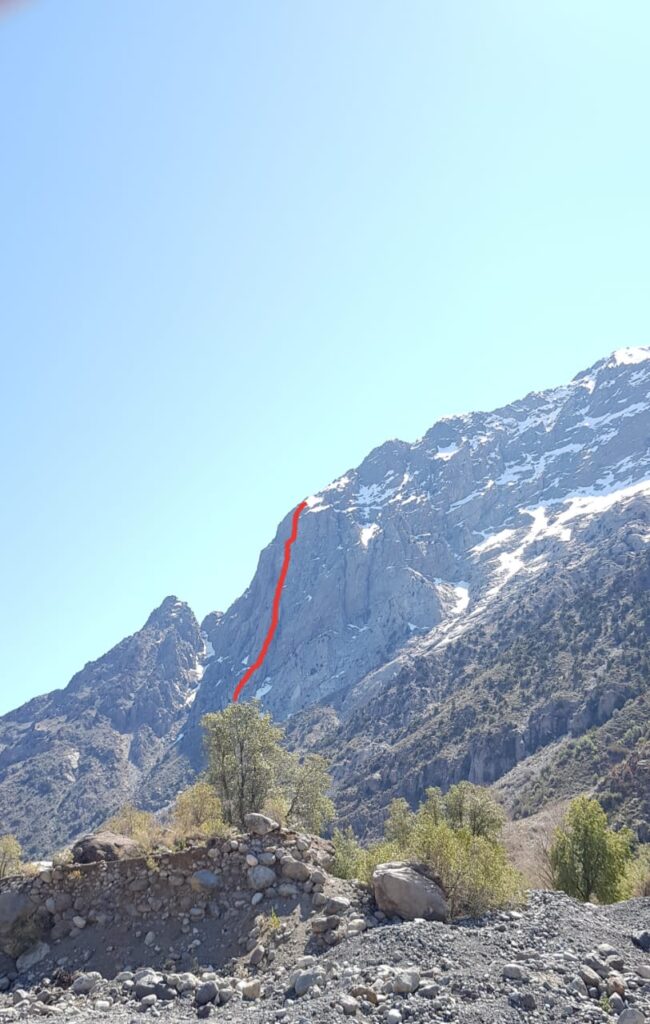
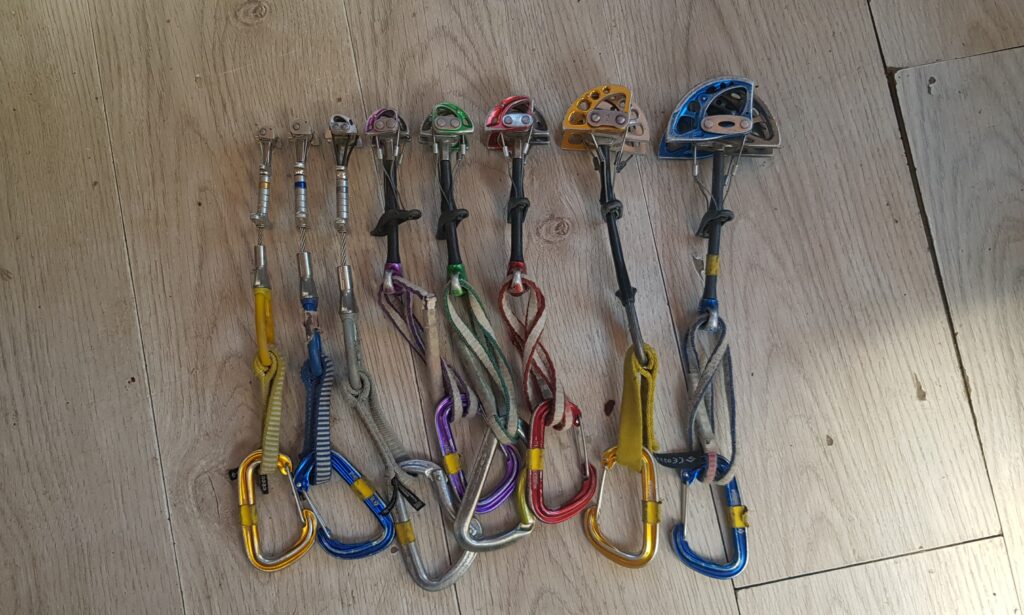
Colombianos is a 450m granite crack climb located in San Gabriel, about an hour from Santiago; it was first ascended in 1982 by a couple of Colombians (thus the name). Get into trad climbing here in Chile and its one of the classic climbs you often hear about. The route, like the others here, wanders about with a lot of variations which can make the line harder and more interesting. As soon as it occurred to me to free-solo it, I felt confident and excited. Rated at 5.10a (multipitch routes are rated to reflect the difficulty of the easiest path up) I expected the most technically difficult sections to be well within my on-sight comfort zone. It is also well trafficked meaning that the route would be for the most part clean (no loose flakes that might break off). However the most reassuring factor is that it is mostly crack climbing. Although uncomfortable and counterintuitive at first, once basic jams are mastered, cracks offer the most secure climbing there is. Easy to read from below, basic cracks are also much more down-climbable than pure face climbing (a very necessary skill). Gimme a #2 splitter vertical hand crack and I would feel comfortable running it out all the way. I expected the main challenge to be route finding and finding the rappel anchors. Thus I had Joaco draw me a crude topo so as to have some guidance and set off with my harness, 70m rope, climbing shoes and a simple set of cams from #.2-3.
Fuck this is uncomfortable. I have my hands in a thin hand crack between the roof and the wall as I try to find a position to mantle over the roof. The wall is slick with no bumps to place my foot on, so I swing my right foot up high past my hands and jam it in the crack just where the roof forms a dihedral with the wall. With my left hand jam and my right foot jammed either side of my right hand, I can release my right hand to reach over and grab the lip of the roof which is a slick slopey feature. Balancing between this and my jammed right foot, I free my left hand and match. As I try to mantle through from this position, my left hand slips off the feature and suddenly I’m falling… and jolt to a halt about two meters below; saved by an old stuck Camelot that I clipped my life-line to just in case. I fell… fucking free-soloing. What the fuck! I hang there stunned for a while. I have never fallen where I shouldn’t. Suddenly my iron-tight confidence and conviction is shattered. I consider retreating. How can I continue convincingly after having fallen off? How can I ever justify to myself that everything is in control when I have fallen?
I bring my focus back to the present; I recognize the chatter in my head as reactionary noise to a past external stimulus that no longer represents the reality of the situation. With my mind calm again I realize that in having clipped the Camelot, I approached the roof in a way that I never would have if I had been with no protection. It’s a subtle mental switch but the difference is real, not simply something I tell myself to convince myself. I unclip myself and step back down to the base of the pitch and calmly begin climbing, clipping the Camelot again and this time using more careful beta to find a jug to the right of the roof that I had missed before. As I advance up the rest of the climb I find my flow again. The pitches pass by in a blur.
What I recall are simple thoughtless sensations; the cool rough texture of the wall on my cheek as I pause in a chimney; the contrast of the blue sky with the snow; the pleasant pressure of a perfect hand jam; the flow of my breath as I dance my way up a beautiful flake with friction smears for feet. In roughly an hour I find myself crawling out of a wet but secure offwidth which represents the last pitch of technical climbing of Colombianos. The day is beautiful with Condors soaring by. I smile and laugh, not for having completed my objective (I still needed to get down) but for the pure joy of the moment.
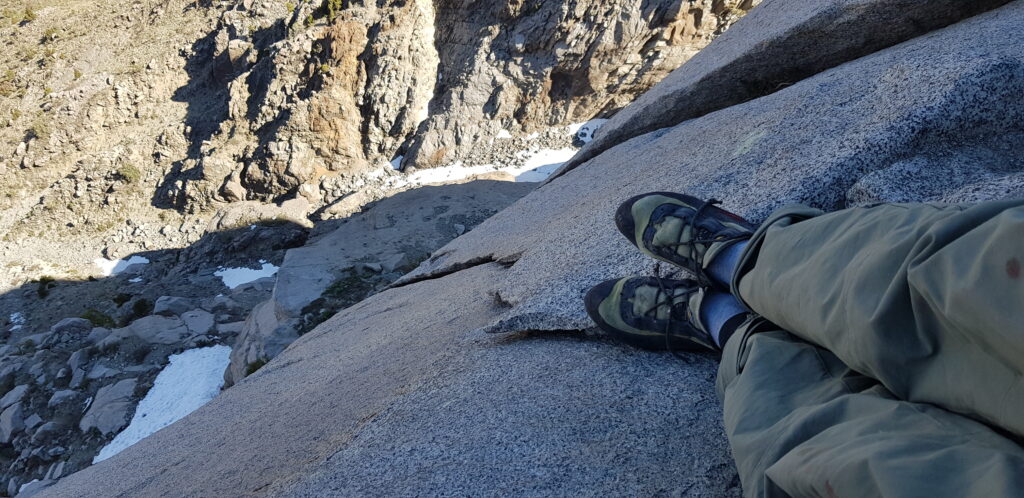
I would go on to free-solo Colombianos two more times during that week but the magic (for lack of a better word) of the first time, the authenticity of the adventure, just can’t be replicated. Even as I write and rewrite these words I struggle to express the pure, raw sensation of being alive that this seemingly reckless and illogical activity gives me. Does it merit the risk? Can I or anyone ever justify to others our actions that do not readily conform to the norms of a society that simply cannot ever understand? Free-soloing will never be something that I practice frequently. Neither will my intentions ever be for any ends other than the pure experience. I deeply value this incredibly fortunate life that I am experiencing and can easily go the rest of my life without taking unconventional risks. However, I find that there are things stirring in the deeper reaches of my consciousness; things that cannot ever be explored by staying within the limits of societal constructs. I believe everyone has these but not everyone has the freedom to pursue them. To those who care about me: Trust me and my process.


Cochamo
Note: I originally wrote this article for a Japanese climbing magazine with a few adjustments hoping to do justice to the place and the Chilean . . .

